
The Wild Geese Sang and They Danced and They Cried
The Wild Geese Sang and They Danced and They Cried
I’ve had a break from the ritual of writing. More than a week, and besides a few scribbles in my journal, hardly a word. Coming back is daunting, as if I’ve never written before. The same way singing can be, and why I try to make sound every day. There’s always a million other things to do.
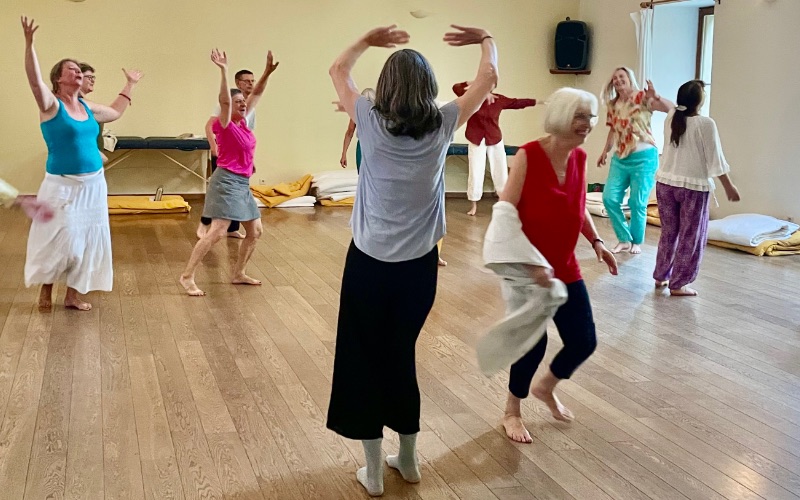
In last week’s post, I introduced this retreat, Voice Activation, on liberating the wild geese within us. I want to share how it actually went. Not to focus on me, or on what a marvelous teacher I am. Just to share what it looked like when eighteen different bodies, eighteen different histories of trauma and recovery, of history, of living, each found their own way into pleasure and sound and movement.
It was the biggest group I’ve had in a long while––large enough that we were given the Temple room. A beautiful big space, oddly angled ceiling with smooth wooden floors great for dancing and reverberating sound back to itself.
Eighteen students, eighteen differences and still so much overlap.
- How to unblock.
- How to be courageous enough to show anger, to let the dark emotions through.
- How to lead their own groups and not lose their voice in the process.
- How to find the tone inside a choir.
Most were over forty. Some in their late sixties, early seventies. That means decades of habit, of shyness or shame, of sound and impulses stuck in the body. A few students had been with me before. When the newer ones grew frustrated––wanting a one-two-three formula to free their voice forever, one of these students told them: trust Deborah, there’s a method to this madness we’re building.
There is. But it isn’t a set recipe. Even a dish you’ve cooked a hundred times can taste different depending on the tomatoes, the onions, the day. Voice and breath are more mysterious still––they shift with what we’re thinking, what we’re unconsciously feeding our own minds, what tension and story we’re carrying without knowing we’re carrying it. I tease my students: allow yourself to be danceable, even when you don’t know the dance.
The first evening, I bring everyone into an open space with music playing, the sort you’d find in a five-rhythms or ecstatic dance. No steps or anything to get right. Not performing for each other, though if someone passes through your space and it feels inviting, a moment of connection is welcome. It’s all about arriving, without judgment and expectation, or at least less of it. About tasting. I call it a cooking class sometimes. We are the soup we’re going to make, and the ingredients are whatever rises up in and around us.
That first night we gathered in a cozy circle and shared what brought us there and what we hoped to leave with. Most had never taken a private singing lesson. Only a few knew anything about the Alexander Technique. The second task is to make a mash of curiosity and not-knowing, to allow ourselves to be safe enough to play. If we’re safe enough to play, we can be curious, and curiosity is the door. Each day, in the open spaces, I put on certain songs I’ve gathered over the years that work like can-openers. Not to sing in tune, not to get it right. Just to see what wants to emerge.
Some had moments of strong anger, others tears or resistance, or an old warning a migraine was on its way. All ways that stop us, that are trying to keep us safe, even when it no longer works. It’s the old stories clinging on. What can feel wrong is the way the nervous system responds. It doesn’t like change because change threatens the stability of staying the same. And yet, people come to such a workshop to experience something new. We need to remember again and again that it may not feel good at first.
I’ve been circling these themes and questions since the 1980’s, since I first trained as a voice, movement and theater teacher. Three years of Alexander Technique training after that. Years of therapy, workshops in breath, in rebirthing, in five-rhythms, in all kinds of voice constellations, shiatsu and tantra and everything else I’ve picked up along the way in my trying to free my own voice and understanding how the body creates sound at all.
I think of it as seducing the nervous system back to its earliest curiosity, back to our early months of being alive, discovering how our limbs moved and what noise might come out of our own mouths and tongues and lips.
It something I never tire of witnessing, all these refreshed discoveries. The way, when playing music in a park, a young family will stop to listen and their toddler’s whole body will start to dance. It wants to move. It wants to sing. It’s only the years afterward, the stories, the shame, the traumas folding in, that teach us not to.
On the last morning, I worked them hard. Warming up, breathing exercises, sounding while walking backwards, yawning until the jaw gave up its grip. Then, with tools for daily practice, I sent them into the forest for an hour of sounding. A beautiful forest with huge old trees that do more than hold our voices, they send it back changed. Some returned with tears in their eyes. They’d fallen in love with the trees, the air, their own voices.
After lunch, for the last hours, I told them to think of it as an encore. Leonard Cohen loved the encore part of his shows: they could run an hour, because one the official work was done, the real fun could begin.
We hadn’t done a full singing circle yet. One of the volunteers in the center turned out to be a fine guitarist who could improvise to my playing. I invited him to join. I started with an improvisation and it opened into a gushing river of song, one after the other. For two hours, eighteen people who mostly never dared like this before, made music that was, without exaggeration, miraculous. Hearts cracked open, all of us on fire with dance and movement and sound. Sometimes someone had to sit back, overwhelmed, in a mesmerizing shock before finding their way back in.
The wild geese flying happily through it all. And for five days, so were we.