
Set Your Voice Free – Barcelona
Set Your Voice Free
I’d arrived hours early to Barcelona airport, a few days ago, just to be cautious and had a couple of hours to wait. I always think I’ll settle in somewhere and do some writing. But before a long flight, I still get antsy and need to move or walk or practice breathing.
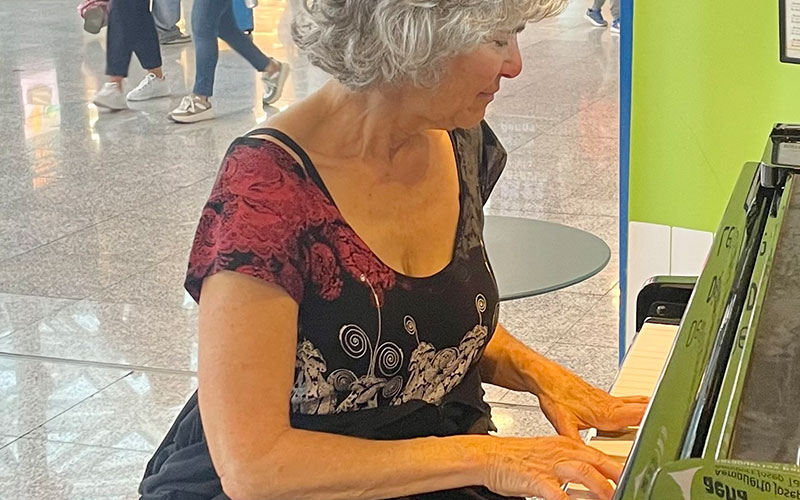
I noticed a free-standing piano in the middle of the terminal with a sign: Play Me. I watched someone finish playing and then walked over. But I hesitated.
I tell people, in every workshop I teach, that something happens when we stop trying to do it right and allow what wants to, to come through. I’ve said it so many times yet sometimes forget and still need to remember.
I sat down, closed my eyes and felt the keys. It was a good piano, in tune, warmed by all the other hands that found their way before mine. All those other strangers who dared to play.
The airport moved around me. Announcements in Catalan, then Spanish, then English. The scrape of luggage wheels, someone’s child running, another crying, the hum of conversation. I was surprised how the music seemed to find the room to be in, to swell open and fill around me. I’d been traveling with my ukulele, and hadn’t played the piano in months. I let my fingers find familiar patterns, warming up. I began improvising, as I’d been doing a lot in my own practice these last months. Listening and responding, the same thing I ask of my students. I added my voice, testing the acoustics, testing myself.
I discovered that wide open space of an airport had a kind of intimacy, the sound traveling differently than I expected. My voice didn’t disappear, it seemed to land here and there, on someone’s smile, a child’s laughter, even a dance.
The critical voice still ran its commentary: Aren’t you too old for this. won’t you annoy people? And the ultimate: who do you think you are to get this much attention? I know that voice well. I’ve spent oodles of hours with my teachers and therapists, and decades helping others recognize that voice and not listen to it. The killer critic that strikes before the first note leaves the throat or the first word reaches the page. I know it’s tricks, I kept playing anyway.
And then the thing happened, the thing I love more than anything, that I write about in all my books. I call it the angel of song taking over. Cohen called it the Tower of Song. Whatever the name, it’s the feeling of sliding into something larger than your own self-consciousness; of being held, carried and given full permission.
When I stopped, people clapped. I turned, and only then realized how many had gathered, mostly behind me. I’d been so inside the music, the outer world no longer mattered.
A woman came forward. She was from Ukraine. Perhaps my age, hard to tell. Had the kind of face that has seen and held a great deal. She leaned over and kissed the top of my head, saying thank you, thank you in a way that held a thousand stories.
She asked if she could take a few photos while I played, and she sent me one, which I’ve posted here. I hope it revealed what I felt: that I was present and unguarded. Like someone who forgot to be afraid. I don’t know her story and she doesn’t know mine, but the music reached into that place we shared, that in-between world where we’re all a bit raw and vulnerable and open. If I’d listened to the voice that said: don’t play, you’re not that good, we would’ve passed through the airport without meeting.
Another woman waited until I’d finished a song. “I’m just divorced,” she said. “Your music made me feel less alone.”
Children danced as they passed, they waved and laughed, and poked their parents to notice. A couple dragged their suitcases closer, settling in. We were finding our way through the waiting time together.
I noticed someone else waiting to play and got up. After she left, I played some more, and then it was time for my flight.
I dared to set my voice free… and only good came of it.
This is what I’ve spent a lifetime learning and teaching: that the voice we’re most afraid to use is often the one people most need to hear.
I work with the Alexander Technique: a practice of releasing the unconscious tension we carry, the bracing shoulders, the held breath, the tight lower back, the inner editor that strikes us down before we utter a sound or write a word. I lead workshops for writers, singers, speakers. I’ve been teaching for years. And still, I almost didn’t sit down at that piano.
Age adds its own particular weight to the hesitation. In my younger years, I could lean on charm and humor to slip past my shyness. Those tools still matter—humor is as essential as ever—but the inner voice that says it’s too late, you’re too old gets more insistent with the years, not less. I notice it and try not to obey it.
What I know from decades of witnessing people find their voice and lose it and find it again is this: the moment of daring is almost never as dangerous as we imagine. The airport was full of strangers. I was exposed, fully visible, in one of the most transient and public spaces imaginable.
Only good came of it. Not because I played perfectly. But because I played.
That’s the invitation I keep trying to extend—in every workshop, every class, every essay here. Not to perform. Not to be brilliant, even if we keep working on our craft. But to show up honestly, to let breath lead, to dare the small act of using our voice in the room we’re in. We don’t need an airport piano, although it was very nice. We can imagine a version of Play Me can be found everywhere, inviting us.