
Dolly and Me and the Way In
Dolly and Me and the Way In
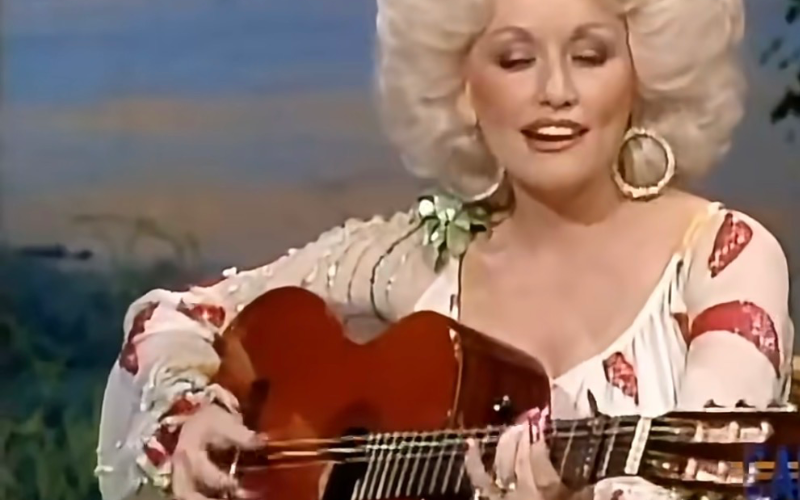
I am seventy-two years old, lying in bed in Oslo with a cup of coffee and my phone, watching Dolly Parton videos.
I have two new books that need finishing, songs to practice, a forest I could walk through. Instead, I keep watching Dolly.
She is laughing, and there is something about that laugh, those dimples, that makes me want to crawl inside her and borrow whatever it is she has. She seems so completely at home in her own skin. I keep coming back to the same question: how did she do that?
I have been a fan for years—sang Jolene as part of my own repertoire, loved her in 9 to 5, where she walked onto a film set with no acting experience and more than held her own against Jane Fonda and Lily Tomlin. I think about my own acting days, how self-conscious I was.
Dolly never seemed self-conscious. Or maybe she was, and simply learned to walk into a room carrying the whole of herself anyway.
That’s what I envy. Not confidence, exactly. Something more basic. Presence.
There’s an old clip of her with David Letterman, who’d just had a baby. She joked she could be the wet nurse. He looked at her, and she rebounded instantly: “Well, if you have a grand piano in your living room, you do want to play it.”
She let herself be foolish. Funny. Never embarrassed by the size of her own personality.
In another clip she says, in that unmistakable hilly voice, “I’ve always wanted to be seen. I love all that attention.”
Maybe that’s the difference between us. I’ve always wanted to be seen too, secretly, all the while trying to hide. I spent much of my life making myself smaller, quieter, less strange. Even tried to get rid of my breasts when I was twelve, pressing down on them hard with a brick.
I grew up poor and learned early how to find money for food, rent, everything. I sang on MacDougal Street in the Village. Then in the Paris Metro and the late-night streets of Saint-Michel, pretending to be Jacques Brel. Then a ski bum in the Swiss Alps, singing wherever I could. Years touring as a singer-songwriter—not Dolly-famous, but enough to build a life around music.
And still, somewhere inside, I’ve often felt like a lost little girl standing outside a door, waiting to be invited in.
I have a David Letterman story of my own that still haunts me. In the mid-90s, with a recording contract in the Netherlands, a friend gave my new CD to her mother, who lived across the street from Letterman in Connecticut, left it in his mailbox.
They actually called. “Would you be ready to fly out at a moment’s notice?”
“Yes,” I squeaked. Perhaps they already heard the fear in my own voice. They couldn’t have someone that frightened on the show. What if I’d shaken through the whole segment, used my few minutes on air to grip his hand because I couldn’t breathe? For years, I’d imagined being introduced on the show as used a marker of how nervous I could get, just in case they phoned back.
Years before that, Lee Strasberg, who I studied acting with, thought I was talented and arranged an audition at the Actors Studio. I was so nervous I ate two pints of Häagen-Dazs and arrived drunk on sugar. He set up a second audition. I never went.
Then he died.
I sometimes imagine Dolly in those rooms—showing up with all her joy, her mountain-sized hair, her jokes, her voice, all of it, and somehow making room for herself anyway. She didn’t separate the acceptable parts of herself from the embarrassing ones. Her humor, her ambition, her vulnerability—they all belonged to the same person. She brought all of herself into the room.
Not me. I was always editing myself down. Too strange, too needy, too much. Yet the people I admire most are exactly that: too much. Completely themselves.
Belonging has been the problem of my life—looking for the place, the person, the work that will finally make me feel at home. Sometimes I find it, for a while. Then something happens, I’m kicked out or I kick myself out, and I start moving again.
Now Dolly is gone, and the whole world seemed to turn toward her at once. My own life is more secure than it’s ever been—a small pension, a room we rent out in our Oslo apartment, enough side work so there’s no more scrambling to survive. And still I struggle with meaning. A week ago I became, for the first time, a reversed snowbird, fleeing a Mediterranean heatwave back to the very city I’m always trying to escape. Two books, unfinished. Nobody waiting for them.
I wake without a plan. Coffee, back to bed, phone, hoping for inspiration. Always looking for the thing that will make me feel grounded enough to get up.
And then another Dolly video: she’s laughing about how she played rhythm on her acrylic fingernails, which helped inspire 9 to 5. Maybe you can be that free when you’re that famous. But I don’t think fame is the whole explanation. I think it’s the willingness to inhabit herself, all seventy-two—all eighty—years of it. And not keep waiting.
There is another kind of home. I’ve felt it in snippets, in my best moments, when the singing takes me over and I stop thinking about myself, when I’m dancing or walking through a forest and remember that I’m alive. Not watching myself from the outside. I’m just there.
I think about the little girl in me who was convinced she never belonged anymore, not to her family, not to this world, who learned to stand outside doors waiting to be let in. I’ve been her a very long time. Maybe that’s why I’m always moving, searching for the next city, the next person, the next revelation, surely the place where I’ll finally belong.
But maybe there is no place. Maybe there’s only the moment you stop waiting to be invited in, and stand in the empty space instead, heart pounding, and say: here I am. Not am I okay, not have I earned the right to be here—just here I am.
I will never have Dolly’s ease. I’ll probably keep trembling and overthinking the things I care about most. But maybe I don’t have to become fearless. Maybe the discipline is simpler than that: get up anyway. Sing and write, with all my foibles. Teach. Walk through a forest because I still can. Finish the books, even if no one’s waiting.
I am seventy-two years old. Maybe I’m not going to solve myself, and maybe that was never the assignment. Maybe the goal is to stop waiting to feel at home before I start inhabiting my life.
Dolly kept singing. She kept showing up. She kept being Dolly.
I have spent most of my life looking for the way in. Maybe it was never a place, never another person or project or revelation.
Maybe it’s simply this: here I am.
Thank you Dolly.